6th Infantry Regiment
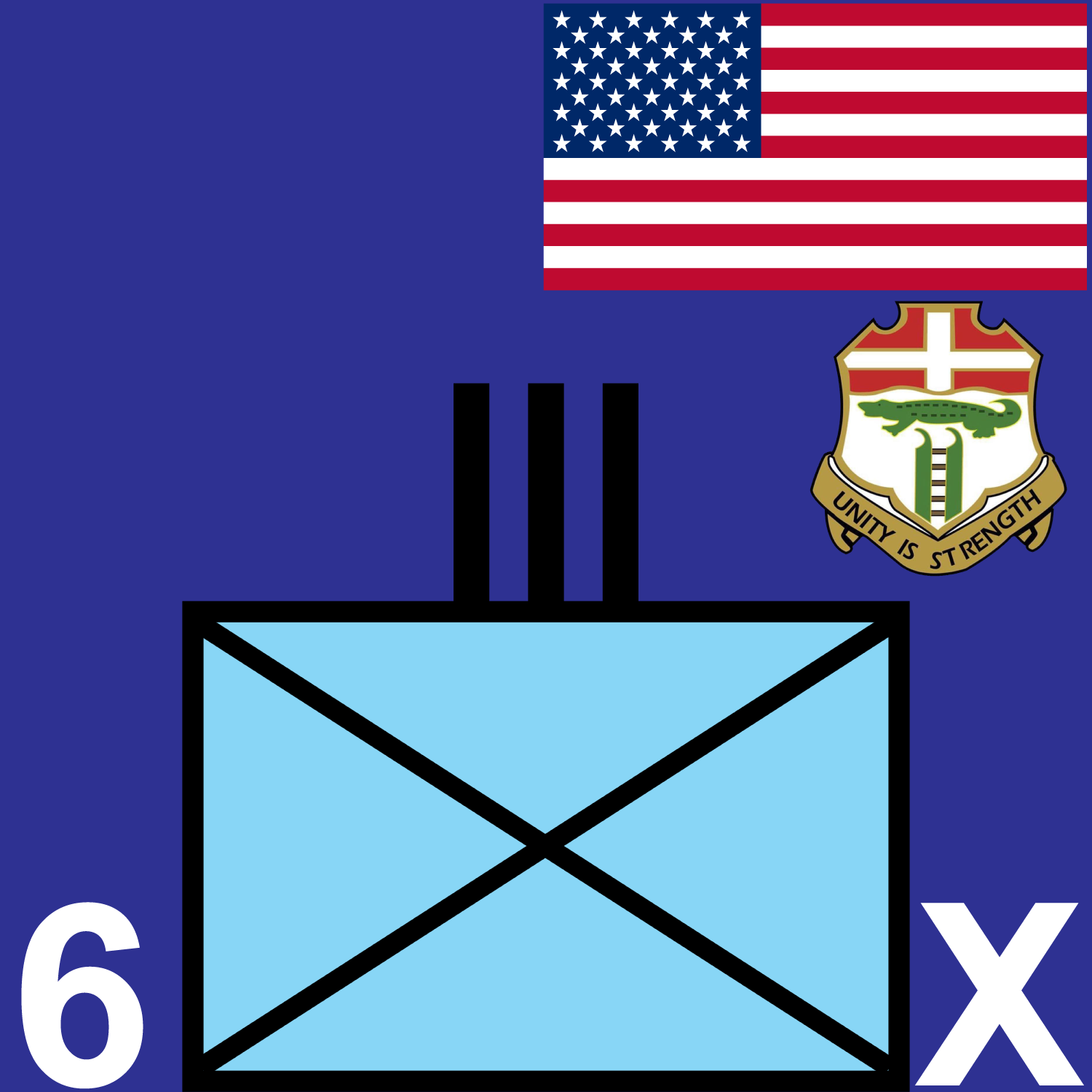
Modern Era, United States, Infantry
The 6th Infantry Regiment, the "Regulars," traces its lineage to 11 January 1812, when Congress expanded the Army in anticipation of war with Britain. Consolidated into the 6th Infantry after the War of 1812, the regiment quickly built a reputation for disciplined regular service. Its famous nickname grew from the Battle of Chippawa, where British troops realized too late that the advancing Americans were not militia but seasoned regulars.
Throughout the nineteenth century the regiment campaigned across the expanding United States. It fought in the Black Hawk and Seminole wars, took part in Winfield Scott's advance on Mexico City, and then moved east for the Civil War. After the war it spent years on frontier duty in the plains and mountain west before adding service in the Spanish-American War, the Philippine-American War, and the Pancho Villa Expedition. By 1917 the 6th Infantry had accumulated one of the more varied records of any regular regiment in the Army.
In World War I the regiment was assigned to the 5th Division on 18 November 1917 and served with the 10th Infantry Brigade of that division in France. It took part in the Saint-Mihiel and Meuse-Argonne operations and shared in the combat record of the 5th Division on the Western Front. After the war the regiment was relieved from the 5th Division in 1921 and later assigned to the 6th Division in 1923.
The regiment's World War II service took a very different form. Relieved from the 6th Division in 1939, it was reorganized as armored infantry and eventually served as part of the 1st Armored Division. In North Africa and Italy its elements fought in the Algeria-French Morocco, Tunisia, Naples-Foggia, Anzio, Rome-Arno, Apennines, and Po Valley campaigns. In effect, the 6th Infantry's World War II combat story is the story of its transformation into the armored infantry arm of the 1st Armored Division.
After 1945 the regiment's battalions moved through constabulary service in occupied Germany and then back into the standard infantry structure. The 1st and 2nd Battalions later served with the 1st Armored Division in Germany during the Cold War. This postwar period made the regiment one of the Army's long-serving mechanized and armored infantry lineages rather than a traditional foot regiment in the older sense.
During the Vietnam era the regiment's battalions again served under different higher formations rather than as one unified regimental combat team. Elements of the 6th Infantry served in Vietnam, but the regiment's modern identity remained particularly tied to armored and mechanized formations in Europe. In later decades its battalions served in Panama, the Balkans, Iraq, and other operations, frequently as parts of the 1st Armored Division. That continuity helps explain why the "Regulars" remained relevant well after the age of classic regimental warfare had passed.
Today the 6th Infantry Regiment is remembered both for its deep nineteenth-century lineage and for its twentieth-century role inside the modern armored Army. Its history runs from Chippawa and Chapultepec to armored warfare in North Africa and Italy, and then forward into the expeditionary campaigns of the late Cold War and post-Cold War Army.
Battalion Page
The battalion subpage collects the regiment's battalion illustrations and additional historical entries with sources. Open the 6th Infantry Regiment Battalions page.
Division timeline, 1916–2026 · assignments, patches and deployments →