33rd Field Artillery Regiment Battalions
Modern Era, United States, Field Artillery
This page collects the existing battalion illustrations and additional documented historical battalions of the 33d Field Artillery Regiment. The historical entries include inactive units and earlier designations; the regimental image identifies entries without a battalion-specific illustration.

1st Battalion, 33rd Field Artillery Regiment
This card isolates the 1st Battalion symbol inside the regiment's five-battalion set. Use the direct battalion link below to open the stand-alone reference page for this battalion.

2d Battalion, 33rd Field Artillery Regiment
This card isolates the 2d Battalion symbol inside the regiment's five-battalion set. Use the direct battalion link below to open the stand-alone reference page for this battalion.

3d Battalion, 33rd Field Artillery Regiment
This card isolates the 3d Battalion symbol inside the regiment's five-battalion set. Use the direct battalion link below to open the stand-alone reference page for this battalion.

4th Battalion, 33rd Field Artillery Regiment
This card isolates the 4th Battalion symbol inside the regiment's five-battalion set. Use the direct battalion link below to open the stand-alone reference page for this battalion.

5th Battalion, 33rd Field Artillery Regiment
This card isolates the 5th Battalion symbol inside the regiment's five-battalion set. Use the direct battalion link below to open the stand-alone reference page for this battalion.
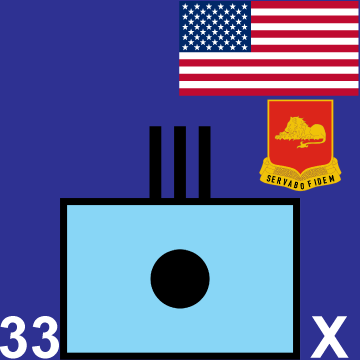
6th Battalion, 33d Field Artillery Regiment
The 6th Battalion, 33d Artillery, was activated at Fort Carson on 1 September 1967. Its first modern period of active service ended with inactivation at Fort Lewis on 28 February 1970.
Redesignated as field artillery in September 1971, it returned to active duty at Fort Sill on 21 November 1975. It was inactivated there on 16 August 1987. Army lineage history, Part 2, PDF page 76.
Research note: The added historical entries cite their sources individually. Regimental illustrations are labeled as such. An earlier battalion designation can continue through another battalion or a separate battery; these relationships are identified in the entries. These additions follow Janice E. McKenney, Field Artillery (U.S. Army Center of Military History, 2010), Parts 1 and 2. The published lineages principally cover developments through 2003; they are not a current order of battle. The original five symbol cards retain their links to individual reference pages.