The Battle of Plataea (c. 479 B.C.E.)
Tag, Tag, Tag, Tag
The Battle of Plataea, fought in 479 BCE near the city of Plataea in Boeotia, was the final land battle of the second Persian invasion of Greece and a decisive victory for the Greek city-states against the Achaemenid Empire. It marked the end of Persian ambitions to conquer mainland Greece and cemented the reputation of the Greek hoplite phalanx as a formidable fighting force.
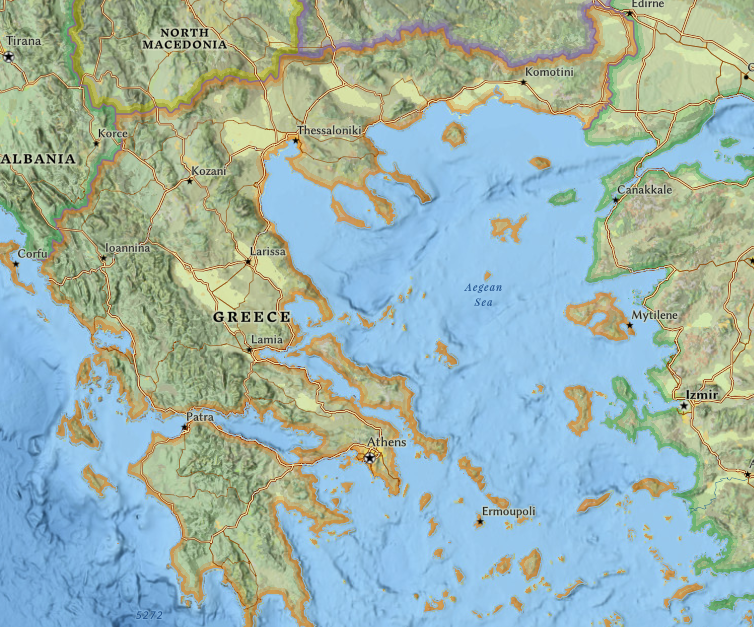
Following the defeat of the Persian fleet at Salamis in 480 BCE, Xerxes I withdrew most of his army back to Asia, leaving behind a large force under the command of Mardonius. Xerxes hoped that a continued Persian presence would coax the Greeks into surrender. However, the Greeks, led by the Spartans, Athenians, Corinthians, and other allied poleis, decided to confront Mardonius in a final stand.
Mardonius occupied northern Greece and tried to fracture the alliance by offering favorable terms to the Athenians. The Athenians refused, choosing instead to rejoin the Spartan-led Hellenic League. This prompted the Greek coalition to mobilize a large army, estimated at around 100,000 men, to face the Persian force—roughly equal or larger in number but composed of a more diverse and less cohesive group of fighters.
The two armies met near Plataea in the summer of 479 BCE. For over a week, the forces were locked in a stalemate, both wary of being drawn into an unfavorable fight. Mardonius tried to disrupt the Greek supply lines and forced a repositioning of the Greek army. Mistaking this movement as a retreat, the Persians launched an aggressive attack.
The core of the Greek army, especially the Spartan hoplites under Pausanias and the Athenian forces on the flank, held firm and began a brutal, disciplined counteroffensive. The Persians, lacking the heavy armor and tight formations of the hoplites, suffered devastating casualties. Mardonius himself was killed during the fighting, reportedly by a Spartan warrior hurling a stone, which caused the Persian morale to collapse.
The disorganized Persian forces fled the battlefield, many attempting to retreat to a fortified camp. The Greeks pursued and stormed the camp, inflicting massive casualties. Only a small number of Persian soldiers escaped, and the Persian command structure was shattered. It was one of the most complete Greek victories of the Persian Wars.
On the same day as Plataea, the Greek fleet also destroyed the remnants of the Persian navy at the Battle of Mycale in Ionia, further crippling Persian military capabilities. These twin victories marked the end of Persian military offensives into mainland Greece and signaled the beginning of Greek dominance in the Aegean.
The aftermath of Plataea was a dramatic shift in the balance of power. The Persian threat had been repelled, and the Greeks began to form a more aggressive alliance—the Delian League—led by Athens, which would evolve into the Athenian Empire. Sparta, on the other hand, withdrew from wider campaigns, preferring to consolidate power within the Peloponnese.
The Battle of Plataea was also a cultural and ideological victory for the Greeks. It confirmed the superiority of citizen-soldier armies over conscripted imperial forces and helped forge a pan-Hellenic identity rooted in resistance to foreign domination. Temples and monuments were built to commemorate the victory, including dedications at Delphi and Olympia.
Modern historians regard Plataea as a crucial moment in Western history. It ended Persian expansion westward and preserved the autonomy of the Greek city-states, allowing classical Greek civilization—and eventually, democracy, philosophy, and art—to flourish. Without the victory at Plataea, the course of Western civilization might have been very different.
Sources
- Herodotus. The Histories, Book IX.
- Green, Peter. The Greco-Persian Wars. University of California Press, 1996.
- Lazenby, J. F. The Defence of Greece 490–479 BC. Aris & Phillips, 1993.
- Holland, Tom. Persian Fire: The First World Empire and the Battle for the West. Abacus, 2005.
- Bury, J.B., and Meiggs, Russell. A History of Greece. Macmillan, 1975.
- Cawkwell, George. The Greek Wars: The Failure of Persia. Oxford University Press, 2005.
- Cartledge, Paul. The Spartans. Overlook Press, 2004.